Those who want the future build it. With MSD. Robotics handles physical tasks; AI connects processes. We work with businesses to develop the path from an initial task to a tested, integrated system.
10,000 AI agents as a scaling target · 46 occupational fields in the atlas · no claim of an operating fleet.
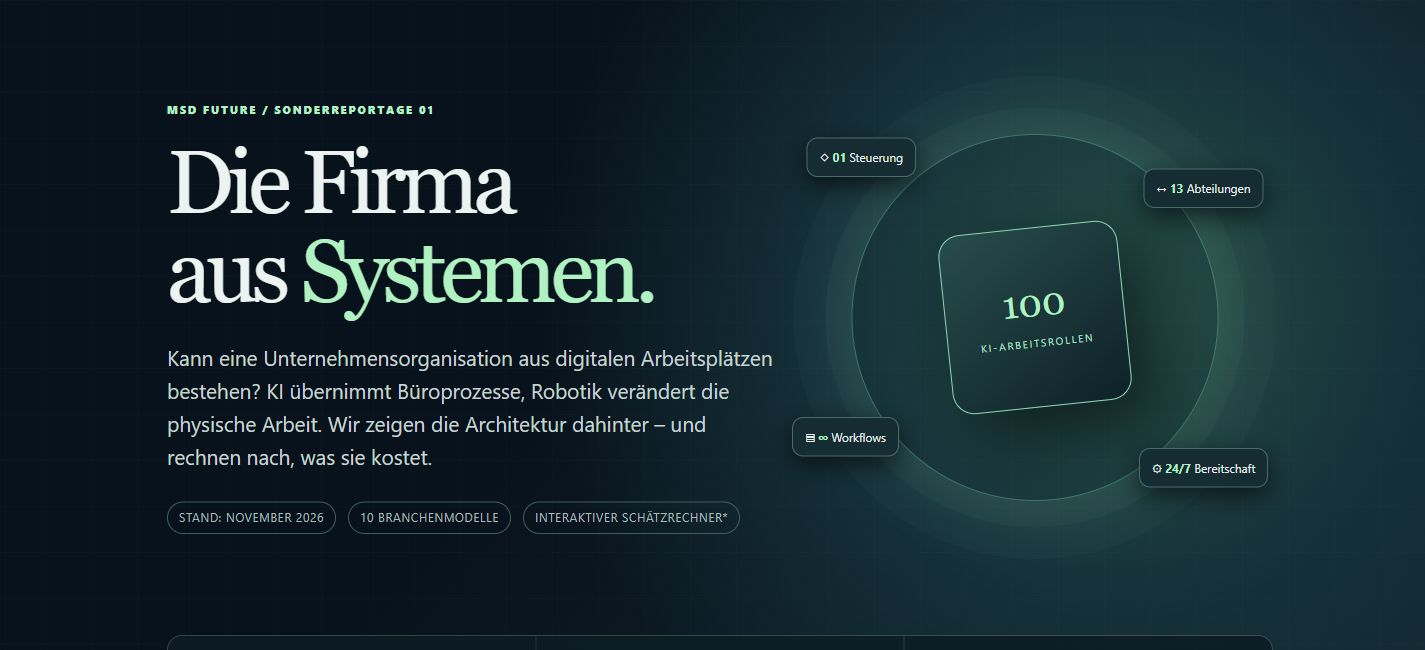
As of November 202610 industry modelsInteractive estimate calculator*
10,000Agents · target vision
◇ 01 Coordination
↔ 46 Occupational fields
▤ ∞ Workflows
⚙ 24/7 Availability
100Specialist roles in the MSD model
13Organisational departments
1Owner with oversight and decision-making authority
MSD / FUTURE / THE CONTEXT
Why robotics? Why talk to MSD now?
Robotics becomes relevant where work is repetitive, physically demanding or difficult to plan. AI can connect suitable digital workflows. Economic value arises when a sensibly selected process works reliably in daily operations – including setup, testing, maintenance and human responsibility.
01
What changes for businesses
A machine can move parts, a camera system can inspect quality, and an agent can pre-sort enquiries. Their interaction is decisive: a fast robot is of little use if materials are missing or office processes stall. That is why we consider the workflow from input to finished result.
02
Why early assessment is worthwhile
Understanding processes, data and bottlenecks today makes it possible to test suitable tasks selectively and learn from the results. More usable capacity, less rework or reduced physical strain may justify an investment. The specific pilot must show whether this is achieved – a demonstration alone is insufficient.
03
What you can build with MSD
Bring a real task from your business: inspecting parts, moving materials or preparing orders, for example. Together, we define its scope, assess suitable technology and interfaces, and design a pilot. Appropriate specialist partners are involved for specialised integration, safety and maintenance.
* Illustrative estimates – not MSD quotations.
All amounts, cost profiles, automation assumptions and calculation results are model assumptions for orientation. They are not binding market prices, an individual quotation or guaranteed savings. Net amounts; 30 calendar days per month. Each actual project is costed individually after process assessment.
01 / Perspective
What if a company consisted of tasks rather than jobs?
Today, work and responsibility are usually allocated through people, departments and staffing plans. Yet much office work consists of clear sequences: capturing data, drafting quotations, informing customers, matching invoices and checking results. These processes can be described, executed and measured in software.
The interesting question is not: “Can AI replace employees?” But: “Which specific steps can be automated reliably, lawfully and economically?”
01
The digital workplace
Each AI role receives its own identity, task description, permissions, tools, test criteria and cost centre. This resembles one computer per existing workplace – although many roles can technically run on shared servers.
02
The connected department
Customer service forwards a problem to the technical agent. Sales requests a cost calculation. Accounting receives verified invoice data. The systems depend on one another, like people in an organisational chart.
03
The physical layer
Where objects must be built, moved or assembled, specialised robotics is added. Sensors, safety, material feeding and maintenance remain part of the calculation. A robot cell is not an all-purpose tradesperson.
Our principle: the model shows technically possible process chains. It claims neither 100 agents operating productively nor an automatic one-for-one replacement of 100 employees.
02 / Organisation design
The new business pyramid.
Leadership remains human. Beneath it, a controlled digital structure distributes tasks, data and execution. Each PC role is linked to the complete system through traceable dependencies.
The owner defines business rules. PC-001 prioritises day-to-day operations. PC-002 assigns approved tasks to digital specialist roles. Critical actions require defined approvals.
2. Coordination → Specialist roles
A quotation is not created by an isolated chatbot: PC-008 checks the enquiry, PC-011 establishes pricing inputs, PC-010 drafts the quotation, and PC-013 prepares contractual documents.
3. Cross-functional controls → Safety
PC-054 assesses risks, PC-059 controls access rights, and PC-060 manages approvals. Executing roles receive only the permissions necessary for their specific task.
4. Technology → Operations
A role may run in a virtual machine, an isolated container or as a managed agent. Physical robots also require control computers, safe machine connectivity and specialist personnel for operation and maintenance.
5. Result → Oversight
Each execution leaves auditable records: input, decision path, output, costs, errors and, where required, human approval.
AI alone does not determine the price. Hardware, development, integration, model usage, electricity, software, safety and maintenance must be considered together. Every example can be adjusted transparently here.
* Estimates in the example scenario. All amounts and results are illustrative net assumptions, not MSD prices or binding calculations. Adapt the inputs to your business; actual effort and savings are assessed individually.
Choose an industry
Example business · Non-binding calculation
Initial investment (net)–Setup + development + hardware + robotics if applicable
Technical operation per calendar day–Digital roles, infrastructure, robotics
Payback from operational start–Only if net savings are realised
Net annual effect–After running costs, before financing/taxes
Adjustments · Inputs change every result
Comparison baseline, not number of bots
Hours worked · Illustrative input; use your own costs
Share of all existing working hours
Productivity does not automatically reduce costs
Physical installation including integration
Illustrative assumption; adapt individually
Factor relative to the example workload
Per existing job; not contracted hours
Initial investment
Monthly operation
Before / After – monthly costs
Cost per job/day – money only, not performance
Digital workforce of the selected business
–
Here, a PC denotes an independent digital role, not necessarily a separate physical device. All individual costs are illustrative assumptions, not negotiated customer prices. A different workforce size may require additional capacity or parallel agent instances.
04 / Infrastructure
Which computers does the digital business need?
Not every role needs its own graphics card. The appropriate architecture depends on whether data must remain local, how many transactions arrive simultaneously and whether real machines are controlled.
Model A / Shared infrastructure
Virtual workplaces
Each role gets its own profile and isolated runtime environment. Multiple roles share servers, databases, storage and AI models.
Low-cost start with cloud or server
Billing by usage and storage volume
Suitable for sales, marketing and back office
Key costs: APIs, processes, oversight
Model B / Dedicated computing
On-premises & GPU hosts
Company-owned workstations or servers host local models and sensitive data. Hardware costs are distributed across the roles actually used.
Higher initial investment
Electricity, cooling, resilience, updates
Predictable local processing paths
Scale by RAM, GPU and throughput
Model C / Physical robotics
AI + machines + sensors
A robot cell connects work planning, a control PC, machine control and feedback. Safety functions must not depend solely on a generative model.
Robots, grippers, sensors, material feeding
CE/machine-safety assessment
Specialist supervision, maintenance, spare parts
Plan by quantity and cycle time
The existing roles form an organisational model, not a fixed bill of materials for 100 computers. The attached JSON architecture lists the direct technical and organisational dependencies for PC-001 through PC-100.
05 / Evidence from today
Not science fiction: this technology is already in use.
The evidence concerns specific workflows, not automatically staff-free businesses. Particularly in robotics, research, pilot operation and commercial deployment differ considerably.
Germany · Manufacturer project · Construction site
890 m² of robotically printed wall surfaces
In Detmold, substantial wall sections of an office and warehouse building are being produced with the mobile INSTATIQ P1 concrete 3D-printing system. It remains a combined process involving design, machine operation and conventional construction.
PORR reports on the masonry robot “Walter” at a construction site in Czechia. The system works with two operators and has been tested in real construction-site operations.
Automated masonry is being developed systematically
The WallBot project by TU Dresden and Grötschel, described for 2023–2026, pursues these research goals: jointly automating measurement, cutting, mortar application, masonry and quality control. This is a development project, not evidence of universal production readiness.
Cost profiles, staffing and automation rates are freely chosen scenario assumptions. The defaults are not official industry indicators verified here. Actual costs, utilisation, throughput and safety requirements can differ substantially. Development, integration, acceptance, operation and human supervision belong in the calculation. Financing, taxes and transition risks require separate assessment.
The role directory. Tasks, dependencies and cost profiles.
The role names and tasks belong to the supplied MSD organisational model. The dependency structure and all example costs were specifically designed for this future model. The library documents possibilities, not an asserted live production status.
MSD INTERNATIONAL / ANALYSIS · ARCHITECTURE · IMPLEMENTATION
What would this mean for your business ?
The key questions are always the same: which tasks recur? Which systems must communicate? Where are approvals required? Which investment genuinely pays off? MSD can outline the individual organisational structure, technical architecture and economics for a specific business.
No blanket promises of savings. Individual assessment considers processes, law, technology, workload, operational safety and financing arrangements.
MSD FUTURE / THE NEXT LAYER
From vision to a future that can be tested.
The original special above presents an organisational and cost model*. Here begins the cross-check: which building blocks have been researched, where do findings conflict, and which assumptions must hold in a real business?
In a randomised trial with 16 experienced developers and 246 tasks, early-2025 AI tools increased completion time by 19%. Participants perceived their benefit much more favourably.
METR · Randomised trialEconomics & Work / Context / 2025
The refined ILO index examines which occupational activities could be exposed to generative AI. It assesses technical exposure, not actual decisions to cut jobs.
ILO · Working Paper 140Robotics & Physical AI / Demonstration / 2024