Design the solution.
Understand the task, select technology, procure components, develop workflows and plan integration with the necessary specialist partners.
 MSDINTERNATIONAL← Home Discover MSD ⌄
From AI and robotics to islands, yachts, specialist partners and new business models. Choose your entry point – and discover what lies behind it.
 AI, robotics & futureFuture · Die Firma aus Systemen
10,000 AI agents as a scaling target, networked tasks and an interactive estimator.
↗ AI, robotics & futureRobotics · 10 platforms
Manufacturers, capabilities, interfaces and integration tasks.
↗ MSD Direct & MarktplatzMSD Direct · Das Portal
People, opportunities, way of life.
↗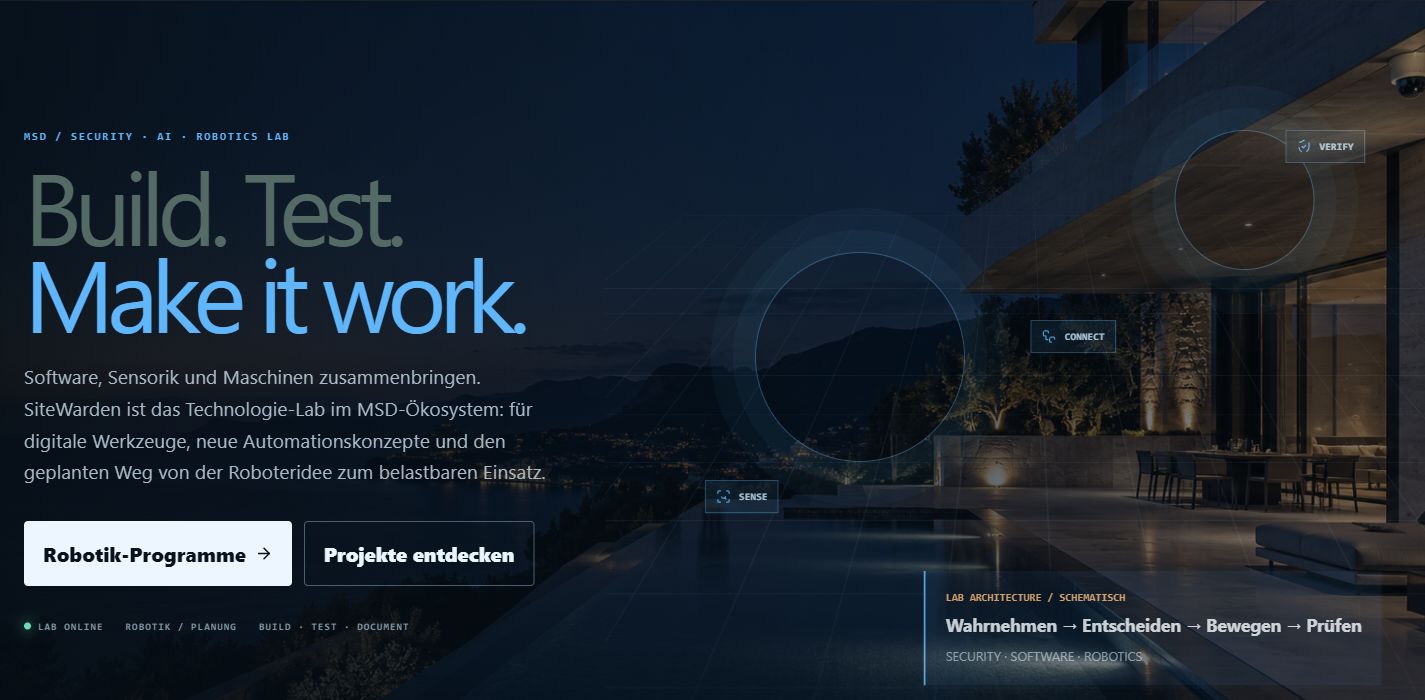 MSD WORLDSiteWarden · Robotics Lab
Gripping, sensor technology and physical AI – planned experimental programs.
↗Die Übersicht wird geladen.
MSD / PROJECT CONCEPTS & SOLUTION APPROACHES
A warehouse with 30 employees, a packing station or an office full of follow-up questions: find a similar task and discover how a manageable pilot could begin.
Robot distribution and procurement, development, teaching, testing and integration – with a clearly bounded goal: approved routine processes operating up to 100% autonomously.*
* A target vision, not a blanket performance guarantee. Engineering and maintenance of operational IT remain specialist responsibilities. Safety, exceptions, maintenance and responsibilities are defined for every process.
Understand the task, select technology, procure components, develop workflows and plan integration with the necessary specialist partners.
Define measurement criteria, failure cases, the test environment and retests. A methodologically separate internal review within the same corporate group; not an independent certification body.
View test concepts ↗36 concrete starting points · concepts, not completed customer projects
Recurring container trips tie up staff between goods receipt, order picking and packing.
The first step: Map one route and two fixed handover points; measure travel, waiting time and exceptions for one week.
Search trips and unclear storage locations delay order processing.
The first step: Define a frequently handled product group with reliable storage-location data.
Returned goods are inspected repeatedly and their data entered more than once.
The first step: Choose one product group and clearly defined condition categories.
The machine waits for the next suitable blank.
The first step: Choose one stable family of parts and one machine; document fixtures and authorisations.
Visual defects are detected too late or assessed inconsistently.
The first step: Choose one measurable defect type with approved reference parts.
Box selection, labelling and handovers repeatedly consume time.
The first step: Test one shipping format and a small number of product variants at one packing station.
Empty spaces are only noticed when customers ask about them.
The first step: Choose one aisle, clearly identified products and a daily inspection time.
Incorrect mappings cause enquiries and corrections.
The first step: Define one product category with unique item identifiers.
Teams repeatedly transfer information from messages into different systems.
The first step: Define one mailbox and one frequent, low-risk enquiry type.
Documents are entered manually and compared with purchase orders.
The first step: Choose one supplier group with structured purchase orders.
Availability is compared repeatedly by message.
The first step: Choose one team calendar and one clearly bounded appointment type.
Approvals and current versions are difficult to identify.
The first step: Choose one document type and an unambiguous versioning scheme.
Repeated lifting strains the team, while inconsistent patterns cause rework.
The first step: Choose one stable box format and one pallet.
Torque, sequence and variant must be correct for every part.
The first step: Choose one product with clear screw positions and quality limits.
Recurring components require similar movements and consistent quality.
The first step: Assess one suitable family of components with a stable fixture.
Large panels require repeated lifting and careful placement.
The first step: Choose one material format and a safe handover area.
Weight, breakage risk and surface quality constrain material flow.
The first step: Investigate one suitable geometry and defined placement points.
Large, suitable floor areas are regularly cleaned using a similar pattern.
The first step: Choose one level, approved zone outside peak traffic hours.
Recurring inspection walks produce inconsistent notes.
The first step: Choose one approved route with measurable inspection points.
Recurring transport trips interrupt service tasks.
The first step: Pilot one floor or one clearly defined transport corridor.
Teams repeatedly travel between service counters, return points and kitchens.
The first step: Choose one safe route without narrow conflict points.
Incorrect combinations are often discovered too late.
The first step: Investigate one line and one approved packaging variant.
Manual handovers create risks of mix-ups and extra documentation work.
The first step: Choose non-critical test samples and a closed process.
Identical parts are repeatedly inserted, tested and sorted.
The first step: Choose one product with a suitable holder and clear ESD requirements.
Incorrect sorting reduces the quality of recovered materials.
The first step: Choose one safe material stream without unresolved hazardous substances.
Suitable areas require recurring maintenance trips.
The first step: Choose one bounded area with a clear operating and safety concept.
Material searches and unplanned handovers delay work.
The first step: Investigate one recurring delivery to a defined staging zone.
Narrow access, moisture and large areas complicate recurring inspections.
The first step: Define one authorised, accessible inspection area without risk to people.
Distributed displays are read and transcribed manually.
The first step: Choose a small group of accessible displays that are not safety-critical.
Unclear stock levels delay repair preparation.
The first step: Choose one frequently used range of parts and clear storage locations.
Variants are repeatedly distinguished and passed on manually.
The first step: Choose one material group with clearly visible characteristics.
Incomplete reports are forwarded repeatedly.
The first step: Choose one non-critical report category without automated decisions on benefit or service eligibility.
Similar orders and materials are easily confused.
The first step: Choose one recurring format with a unique order ID.
Recurring approvals, status checks and documentation occupy specialists.
The first step: Choose one read-only or reversible operation with clear authorisation.
Charge levels, deployment plans and handovers are considered separately.
The first step: Choose one small internal vehicle fleet with available data.
Regular material trips interrupt specialist activities.
The first step: Define one non-clinical material flow and approved areas.
Bring the task, volume, variants, bottleneck and existing technology. The first useful step may be a data check, a time study or a process improvement without robots.
Discuss a project ↗